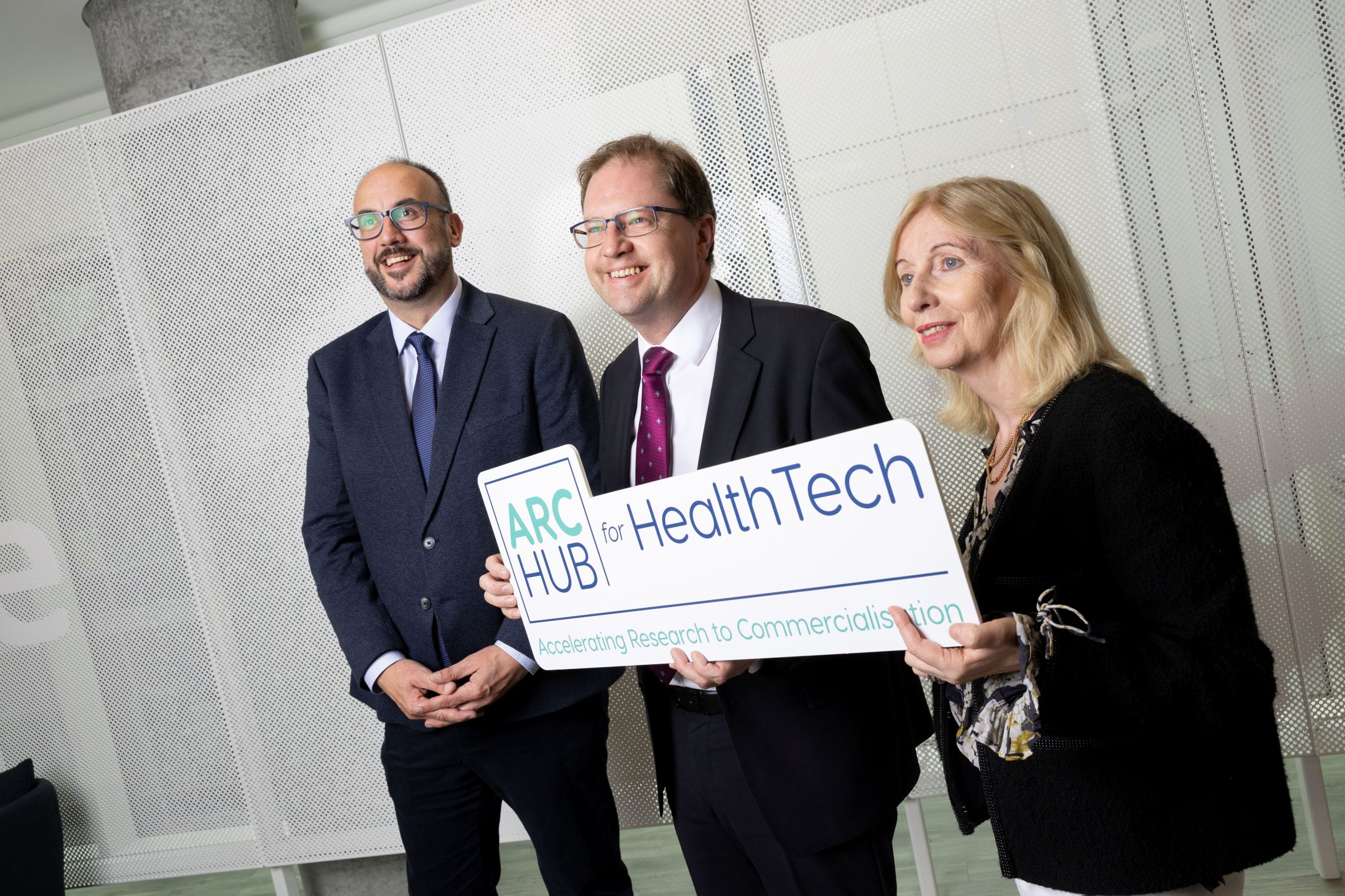

With a €34.3 million investment, the new ARC Hub for HealthTech is set to supercharge the West of Ireland’s MedTech ecosystem. Cois Coiribe sits down with its new leader, University of Galway alumnus Professor Garry Duffy, to talk about his journey from the anatomy lab to commercial spin-outs, and why the future of global healthcare is being shaped right here in Galway.
Cois Coiribe (CC): Garry, to set the scene for our readers, could you introduce yourself, tell us a little about your journey to this role, and explain what the ARC Hub for HealthTech is? Why is this such a significant moment for University of Galway and the wider region?
Garry Duffy (GD): As a proud double graduate of University of Galway, BSc and PhD, stepping into this next chapter feels deeply personal. My career has taken me from the anatomy lab through biomaterials and drug delivery research to co-founding two medical device companies right here in Galway
Today, I lead the ARC Hub for HealthTech, which proudly joins initiatives like BioInnovate, Health Innovation Hub Ireland (HIHI), and CÚRAM in promoting innovation for healthcare. Hosted by University of Galway in close partnership with ATU and RCSI, the ARC Hub supports projects across MedTech and connected health by accelerating their translation into scalable commercial solutions.
Galway is already recognised as one of Europe’s primary MedTech destinations, home to world-class multinationals and a deep pipeline of indigenous companies. The ARC Hub is not a replacement for what exists but rather a new catalyst, designed to work with and amplify that ecosystem, accelerating the journey from research discovery to patient benefit.
CC: There are already 23 projects in the ARC Hub. What kinds of innovations are we talking about, and what does a project need to demonstrate to be selected for support on the road to commercialisation?
GD: The ARC Hub currently has capacity for approximately 20 more projects in addition to those 23 already supported, with research varying from smart implants, wearable diagnostics, and digital health platforms to novel drug delivery systems. What unites these projects is a credible pathway to clinical impact. To be selected for the Hub, a project must demonstrate a genuine clinical need, a technology that addresses that need in a way existing solutions cannot, and a research team prepared to engage seriously with the commercial journey. Northern and western regions of Ireland already have the companies, the talent, and the manufacturing expertise that many global regions can only aspire to. We want the research coming out Irish universities to feed that ecosystem with the next generation of innovations, ones that are developed here, validated here, and then scaled globally to transform patient care.
CC: For readers who may not be familiar with how research moves from lab to market, what does that journey typically look like for a project entering the Hub, and how does the ARC Hub accelerate it?
GD: Most people are genuinely surprised by how long and highly structured the timeline to commercialisation is. For a medical device, it takes anywhere from eight to twelve years to go from initial concept to clinical use. Researchers have to navigate a complex maze of intellectual property (IP) protection, regulatory strategies, preclinical and clinical validation, and commercial scale-up. The ARC Hub accelerates this timeline by ensuring researchers avoid the costly years so often lost to unnecessary, avoidable mistakes. We provide embedded expertise in regulatory affairs, IP protection, clinical trial design, and investor readiness. My own experience founding FeelTect, which moved from a lab concept to a CE-marked product with commercial sales in approximately six years, taught me precisely where those bottlenecks are. That firsthand knowledge underpins what the ARC Hub offers. By sharing this information, we all learn collectively.
CC: Many University of Galway graduates recognise their lecturers and researchers as first and foremost inspiring scientists. How does the Hub support the development of the commercial skills and confidence to become entrepreneurs?
GD: This is the question I find most personally compelling. University of Galway has produced outstanding scientists and clinicians for generations. Many alumni will remember being exposed to brilliant researchers and minds during their studies, be it in final year projects or student-selected components.
The ARC Hub asks those same researchers to develop a ‘second fluency’ in the commercial and entrepreneurial skills required to bring their discoveries to market. We are building structured development programmes, connecting researchers with experienced founders and clinical advisors, and making it possible to think commercially. The best health entrepreneurs I know remain scientists fundamentally. They have simply learnt to ask one additional, vital question: who will pay for this, and why?
CC: Getting medical technology in front of clinicians and patients early is crucial. How are those clinical pathways being structured, and what role do hospital and healthcare partners play?
GD: Getting a technology in front of clinicians early is not just a smart strategic move, it is translationally necessary. Too many medical devices have been developed with minimal clinical input, only to fail when they meet the reality of a busy ward or operating theatre. The ARC Hub has structured clinical partnership pathways that allow researchers to engage with frontline clinicians from the earliest feasibility stages. These relationships are reciprocal. Clinicians bring the real-world need and the necessary reality check, and our researchers bring the potential technological solution. Galway’s MedTech industry has long understood this culture of clinical co-development, and we are embedding it into our research translation pipeline from day one, with a number of leading clinician-academics sitting as a core part of the ARC leadership team.
CC: The ARC Hub’s tagline is: Regional Roots, Global Presence. For alumni at home and abroad, what does that mean in practice, and where do you see these Galway-borne innovations making their mark globally?
GD: ‘Regional Roots, Global Presence’ is not a marketing slogan. It describes how health innovation actually works. The clinical insights shaping our technologies come directly from Irish patients and Irish healthcare settings. However, the partnerships, regulatory pathways, and markets are entirely global.
Galway has already proven that a region can be simultaneously rooted in place and community as well as internationally significant. You only have to look at the sheer scale of MedTech employment and expertise concentrated in the city. The ARC Hub builds on that foundation deliberately and systematically. We are targeting to have nine spin-out companies by December 2029. Ultimately, I want to see companies founded here in the northern and western regions of Ireland, with products used by patients in across the world in Boston, Tokyo, and São Paulo, for example – perhaps our University alumni will be delivering these solutions.
CC: The ARC Hub was established with a €34.3 million investment from the Government of Ireland and the EU. What does that funding make possible, and how will you measure success over time?
GD: The €34.3 million from Research Ireland buys two things that researchers and early-stage companies consistently lack: time and expertise. It funds the people who guide projects through complex regulatory submissions, the networks that open clinical trial sites, and the investor readiness programmes that prepare founders for serious funding conversations.
When it comes to measuring success, we are focused on the metrics that truly matter. These are making sure that spin-out companies are incorporated, patents are granted, venture investment is raised, clinical trials are initiated, and that ultimately products reach patients. This investment strengthens what Galway has built over decades and adds a dedicated translational layer to a MedTech ecosystem that is already the envy of comparable regions across Europe.
CC: What has surprised you most since the Hub launched, and what advice would you give to a University of Galway graduate with a healthcare innovation idea who is unsure where to start?
GD: What has surprised me most is the sheer volume of latent entrepreneurial energy in our research institutions, and how quickly it surfaces when people feel genuinely supported. We have already received more than 60 project submissions from University of Galway alone. If I could give one piece of advice to any graduate with a healthcare innovation idea, it is this: do not wait until your science is perfect before you start engaging with commercial and clinical questions. Those questions will sharpen your technology, not compromise it. Reach out to us at the ARC Hub, talk to Enterprise Ireland, and speak to the clinicians in your network.
Galway City has the companies, talent, clinical partners, and now a University of Galway-led programme built specifically to take HealthTech solution from an idea to global impact.


 Articles
 Podcasts
 Videos
 Publications
 Change Makers
 New Horizons
 In Focus
 Innovate Together
 Global Impact
 SDG Champion Edition
 Creative Galway
 Sustainability
 Equality
 Arts
Arts Business
 Law
Law Medicine
 MedTech
 Science
 Sport
Sport Sustainability
 Impact Toolkit & Case Studies
 Events