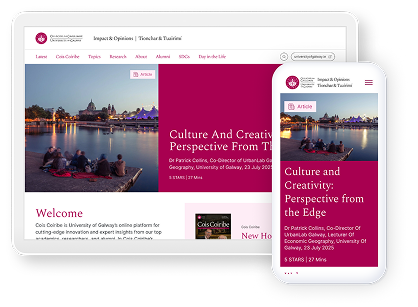
In this article, Cois Coiribe connects with Dr Patrick Collins, Lecturer in Economic Geography at the University of Galway, an Editor for the Irish Journal of Arts Management and Cultural Policy (New Voices), and, alongside Prof Ulf Strohmayer, is Co-Director of UrbanLab Galway. Currently, he is also a Visiting Scholar at University of Cambridge. Here he discusses the innovative, multi-country IN SITU project alongside Galway’s creative communities.
It’s that time again. Those in Galway long enough recognise the turn. The city shines with a slightly different hue, its backing track punctuated by a new and different rhythm; colour, smiles, and a move away from the predictable becomes palpable. Few need reminding that it is festival season in the City of Festivals. Galway gets this one month to travel the world without leaving home.
As a geographer – one that is old enough to know better – I wonder how I can continue to be surprised by this spatial legerdemain. The ability of our small town to move all the way from the edge to the centre by staying perfectly still. But each year it happens. Galway, on the edge of a country on the edge of Europe, becomes the place to be; the place to celebrate culture, the place to listen to stories, the place to honour exactly what it is to be human.
This concern between the edge and the centre – between the core and the periphery – has come to influence a considerable amount of my work. From the story of Ireland’s place in global production networks of the world’s largest technology companies to better understanding how culture resides differently in the periphery. Much of my work can be reduced to the fact that geography is uneven, and to discount the periphery is to commit a serious form of sophistry.
IN SITU is a four‑year Horizon Europe research and innovation project (Grant Agreement 101061747) focusing on helping cultural and creative industries (CCIs) flourish beyond major urban cities. At its core, IN SITU aims to understand and support Cultural and Creative Industries (CCIs) in non-urban areas, where smaller cities and rural regions are often discounted as peripheral yet are vital engines of innovation, sustainability, and social cohesion.
University of Galway plays a part in this project, which operates through six place-based IN SITU Labs – or six collaborative hubs across Europe:

Azores (Portugal)
The Azores, an ultra-peripheral region of Europe, is an autonomous region of Portugal located in the North Atlantic, 1500 km from the European mainland. The archipelago is of volcanic origin and comprises nine islands and several islets which belong to three geographic groups. Approximately 237.000 people are resident across the nine islands (2021 Census). It is one of the four Portuguese regions (NUTS 2 level) belonging to the category of less developed regions.—insituculture.eu

Galway (Ireland)
The land of this coastal periphery area, situated in the West of Ireland, contains a mix of mountainous and bog land. While oftentimes providing a dramatic backdrop, it has low agricultural productivity. A total of 270,000 people live in the region, which represents a low population density marked by a significant level of outmigration in the under 30s, especially in more peripheral places, with in-migration to larger urban settlements.—insituculture.eu

Western Region (Iceland)
The West region of Iceland, located on the northern periphery of Europe, stretches from the sea to inland. West Iceland has vast nature, and within the area there are various beaches, glaciers, wetlands, and mountain areas. There is one national park and several listed natural monuments. The region is mainly composed of rural areas featuring nature, agricultural land, and seaside villages. There are 16.700 inhabitants in ten municipalities. The largest community in West Iceland is Akranes, in the southernmost part of the region, with 7400 inhabitants.—insituculture.eu

Rauma–Eurajoki (Finland)
The cities of Rauma and Eurajoki are located on Finland’s Southwest Coast. The region is a boreal/hemiboreal, old agricultural area with long historical continuity. It is accessible, close to the regional centre of Pori and a few hours away from major national centres. The rural landscape is a mosaic of fields, forests and settlements with a low relief. The adjoining Bothnian Sea archipelago is a fringe of smallish islands by the Baltic Sea that borders Sweden. There are about 30.000 inhabitants in the rural areas of the IN SITU Lab, mostly Finnish-speaking. The local level of employment is fair, the most important sector being services and the second primary production (agriculture and fisheries). The City of Rauma has Mediaeval origin and the surrounding rural areas have varied and stratified cultural heritage. The Old Rauma and rural Bronze Age Burial Site of Sammallahdenmäki are World Heritage sites. There is also a national park in the Bothnian Sea archipelago. Local environmental pressures are related with the eutrophication of the Baltic and the impacts of large-scale wind turbine development. Eurajoki also has a nuclear power plant with a controversial spent nuclear fuel repository soon to be made operational.—insituculture.eu

Valmiera (Latvia)
Valmiera county is located in the northeastern European periphery, inland, on the border with Estonia. The city of Valmiera is an old medieval town, and a member of Hanseatic league. Unfortunately, the built cultural heritage has been lost, as almost all historical buildings have been destroyed, many of them during World War II. However, Valmiera also features rich industrial traditions and leads the nation in output produced per capita. Valmiera is also a recognized sports centre.—insituculture.eu

Šibenik–Knin (Croatia)
Šibenik-Knin County is situated in the southeastern European periphery, on the Croatian Adriatic Coast. The total area of Šibenik-Knin County is 5,670 km2 (2,994 km2 land, 2,676 km2 sea) including 285 islands. The Šibenik-Knin County has 96.624 inhabitants and Šibenik (administrative centre) has 42.589 inhabitants (2021 statistics). The economic and transport isolation of this area has conditioned negative demographic and socioeconomic trends that are expressed in higher at-risk-of-poverty rates.—insituculture.eu
In these Lab areas, these grounded, locally embedded teams work not as external observers, but as active participants. Culture is mapped not only through statistics and inventories, but through conversations, walks, gatherings, and imaginings. The teams listen. They provoke. They co-create. The result is not a definitive answer, but a chorus of insights.
Working collaboratively as universities, cultural practitioners, local authorities, and community groups, new models of cultural mapping, creative governance, and policy alignment are co-designed and tested. Through IN SITU, our goal is to generate empirical and conceptual insights that help CCIs become resilient, connected, and transformative forces in their locales.
What sets IN SITU apart is its hybrid lab-based approach – a bridge between rigorous research and place-rooted experimentation. In Galway, for example, UrbanLab Galway has spearheaded workshops, creative-focus groups, and mapping exercises to uncover how culture is lived, valued, and imagined in the West of Ireland. IN SITU case study projects in this region include :
The Voice of Youth (Guth na hÓige) project is developed by Shane O’Malley Artist & Marcus O’Connor – West Murals and addresses place-based issues of youth and community development. The project covers the thematic strand of activating communities.
In Gort, the Art in Gort (Art Inse Guaire) project addresses the place-based issues of youth and community development, including engaging with young people in place-making, and of governance and local development that encourages democratic engagement and collaborative placemaking. The project covers the thematic strands of activating communities and intra-sectoral collaboration.
Case studies across our edge regions bring artists and communities together to explore the role of culture in the making of these places. Through these methods, we’ve identified two key insights:
Cultural vitality in these places doesn’t mimic urban models. It grows from the landscape, language, and lived experience of each region.
Creative activity is most sustainable where it is woven into the social infrastructure of its place.
Our forthcoming book looks at the first two years of this project and gathers a collection of stories about how culture is made at the edge. These are not just stories of place, but stories shaped by place – by the curve of coastlines, the cut of stone; by the wind, rain, and snow. Each chapter examines culture-making from a different corner of Europe, but all share a similar vantage point: a view looking inward from the far-flung, tracing the line between the local and the universal, between rootedness and reach.
The core proposition is simple, yet conversely far from simplistic. It postulates that the periphery is not a deficit, but a dynamic. The edges generate. They shape. They endure and they inspire. From the Azores to Connemara, from the fortress towns of coastal Croatia to the boreal settlements of Finland, our authors have uncovered not only cultural practice, but cultural resilience – a choreography of creativity shaped as much by limitation as by abundance.
In the stories of how creativity lives on the edge, shared threads emerge like rivers at a confluence. Each Lab worked with the grain of its region.
In Galway, the festival city, culture becomes a vessel for language survival as much as for economic growth; in Iceland, saga and site entwine to turn heritage into horizon. In Valmiera, choirs don’t just preserve folk traditions – they animate barn lofts, resound across borders, and carry history forward. In Finland, lacemaking isn’t just craft – it’s continuity, a thread that ties generations to forest, to family, to the feeling of being of a place.
We also found shared tensions. Infrastructure – its presence or absence – was never a neutral backdrop. In almost every region, creatives spoke of the struggle to move people and ideas; of long drives, infrequent buses, patchy broadband, and rehearsal rooms that come and go like migratory birds. The creative act, it turns out, is often less about inspiration than about improvisation. These are not cities where you fall out the door into an arts district. These are places where the arts are sometimes built in barns, or take root in disused factories, or ride tandem with tourism just to survive.
And yet… the ideas that arise from these places often stretch further than those born of the centre. Perhaps it is the necessity of looking outward – of turning geography into invitation – that gives rise to more agile, community-rooted models of development. Perhaps, too, it is the knowledge that nothing is taken for granted – space, time, funding, audience – that leads to cultural forms that are responsive, relational, and relevant.
The IN SITU project considers not only Europe’s engines and centres, but its outposts and promontories.
Its edgelands. Its beginnings. And its elsewhere.
We are rightly proud of our Galway. Of its ability to transform and morph. We know this place as a Galway that has been inspired by its geography – a place that can tell stories. A place where people come from far afield to listen to those stories. And it would be remiss to ignore that many of these tales – imaginative, evocative, and altogether a narrative of us – are borne, cultivated, and reared on the fringes. Histories, arts, and archives, shaped as a manifestation of the creative edge.


 Articles
 Podcasts
 Videos
 Publications
 New Horizons
 In Focus
 Innovate Together
 Global Impact
 SDG Champion Edition
 Creative Galway
 AI & Human Creativity
 Sustainability
 Equality
 Arts
Arts Business
 Law
Law Medicine
 MedTech
 Science
 Sport
Sport Sustainability
 Impact Toolkit & Case Studies
 Events