
Reflecting on Ireland’s first half-century of educational scholarship and teaching-inspired research
In this Cois Coiribe article, Prof Tony Hall traces the historic roots of the Educational Studies Association of Ireland (ESAI), from its inaugural ‘First Meeting of Scholars’, held in Galway in April 1976, through to key events and milestones leading to the 50-year commemorative event hosted by University of Galway, bringing the association back to its place of origin. Starting in 1970s Galway, the ESAI would become one of Ireland’s most important organisations for educational research and scholarship, north and south.
April 1976: A Formative Year for Educational Research in Ireland
Interest in educational research is at a key moment in Ireland today; the scholarship of teaching is experiencing an exceptional period of unprecedented innovation and growth. In November 2025, the Department of Education and Youth hosted its First Annual Educational Research Summit at Croke Park, launching the Futures Oriented Educational Research Network. Open to all educators, researchers, and teachers, this collaboration brings education partners together to promote, undertake, and share research, with the aim of enhancing the educational experience of all learners. The National Convention on Education – the first in Ireland in over 30 years – facilitates a national conversation among all stakeholders, including pupils and parents, on the kind of educational system we want and need for Ireland’s future.
Innovative government-funded initiatives, such as T-REX: Teachers’ Research Exchange, are promoting school-based research and funding, and supporting teachers to become teacher-researchers, potentially helping to bridge the gap between practice and theory in Ireland’s education system so we can benefit from the positive impacts of educational scholarship and research data.
The formative beginnings of educational research in Ireland, focusing on the establishment of the Educational Studies Association of Ireland (ESAI), owes their existence to a pioneering meeting that took place at University College Galway (or UCG, as University of Galway was then known), from April 8th–10th 1976. Here we look at the central importance of evidence and educational scholarship, significantly initiated in UCG in 1976, in advancing and safeguarding inclusive educational futures. Ireland’s story is illustrative in highlighting how, when we acknowledge evidence and deploy it for social inclusion, we ensure the future peace and prosperity of all.
A Historic Look at ESAI’s Origin and Roots
This year marks the ESAI’s first half-century as the flagship educational research organisation for the advancement of educational scholarship in Ireland, north and south. Ireland in the 1970s was divided by a violent and tragic sectarian war, with 1972 the deadliest year of the conflict; Bloody Sunday happened in January 1972. Against this, backdrop of division, the pioneering first meeting was convened.
The organisation of the first conference was chaired by the Professor of Education, Eustás Ó Héideáin at the University, collaboratively supported by two colleagues and doctoral students, John Marshall (a future Dean of the College of Arts, Social Sciences & Celtic Studies) and James McKernan, who were each responsible for inviting delegates from both the north and south of the island. It was through an exchange of letters (and not email as we are so accustomed to today) that the meeting was arranged. For the first time in 1976, scholars, academics, policymakers, teachers, and educators from north and south would come together in person to discuss educational scholarship and teaching-informed research.
The preface to the first proceedings evokes the inclusive ethos and welcome for all educators and scholars of teaching, an ESAI tradition which remains to this day.
“It was a chance exchange of letters between a member of the staff of University College Galway and a colleague in the New University of Ulster that led to the decision to organise the Galway Conference. It was to be not simply an occasion for colleagues north and south to meet one another, although this was an incentive to those who planned it. Essentially, it was to be an occasion when members of the staff of Irish educational institutions and teachers would be together en famille to share their concern for education and to discuss the findings of current research. The Conference was a success beyond the hopes of those who planned and organised it.”—Eustás Ó Héideáin, Proceedings of the Education Conference, 1976
A Retrospective on the Transformation of Educational Research
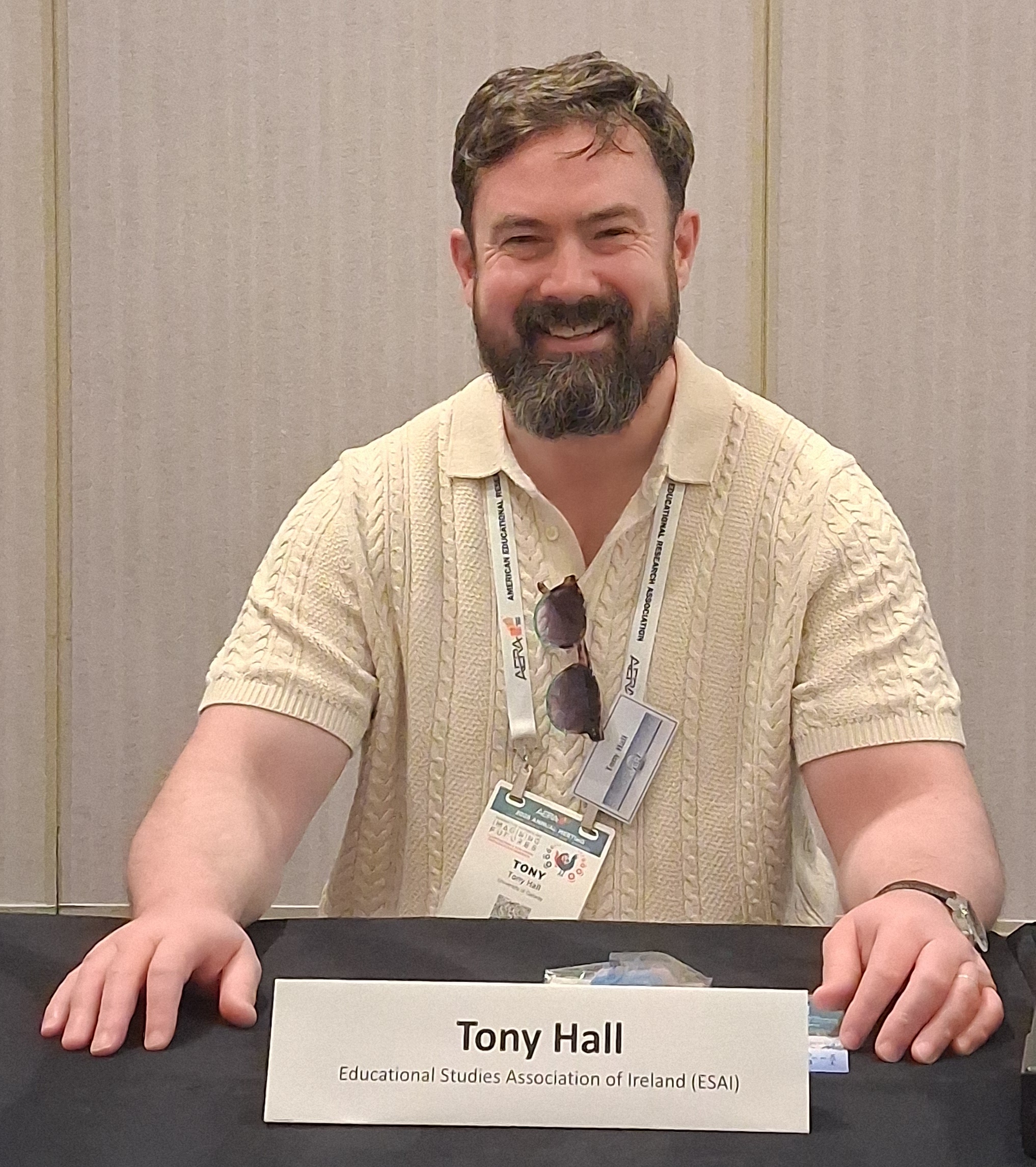
The ESAI is rightly proud of its now 50-year history as a leader in the promotion of the application of evidence to ensure inclusive education for learners of all ages, across all contexts: formal and informal, pre-school, primary, secondary, and tertiary. Fittingly, May 2026 saw the annual ESAI conference returning to Galway, where it all began.
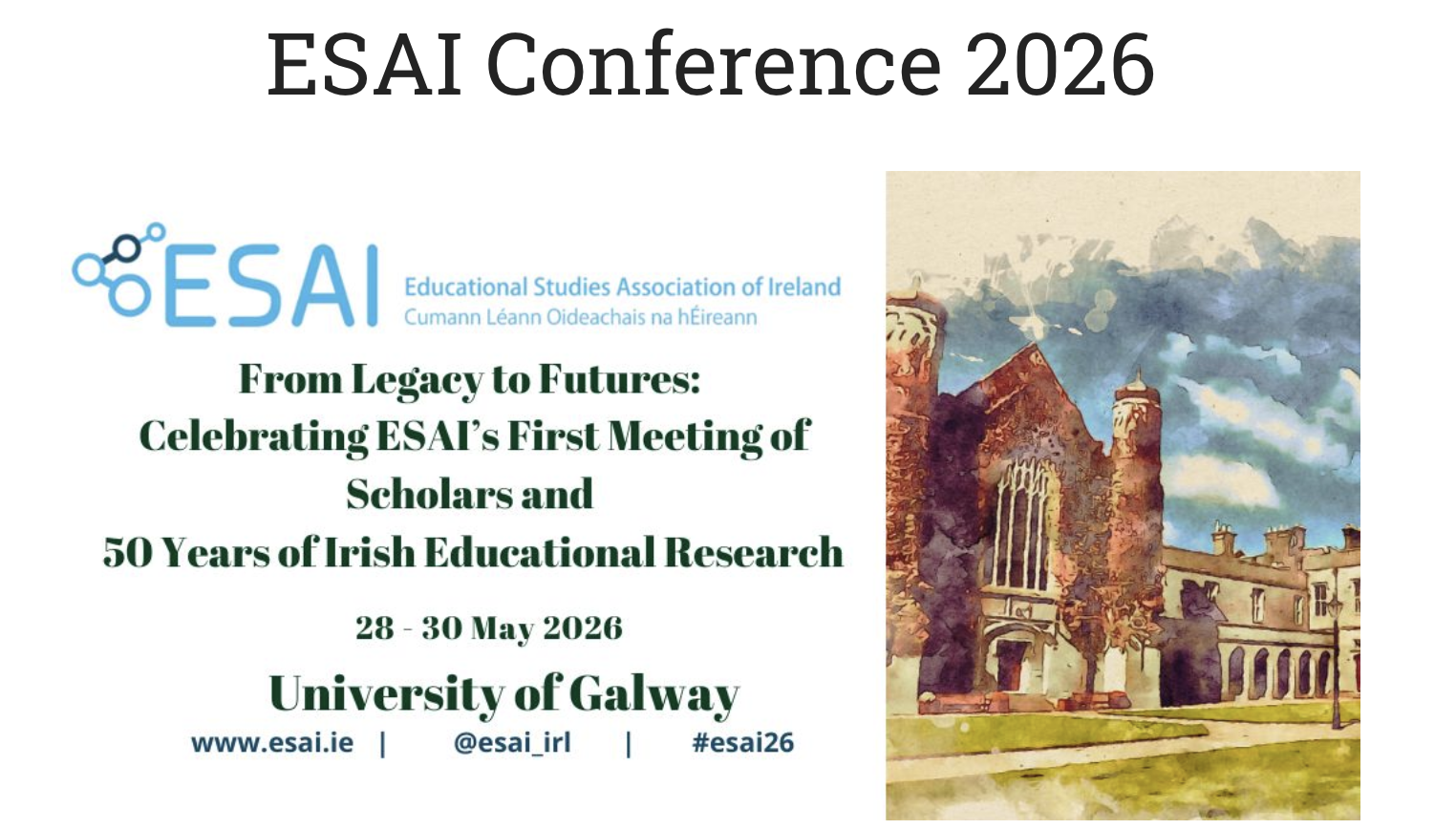
The 2026 conference theme From Legacy to Futures: Celebrating ESAI’s First Meeting of Scholars and 50 Years of Irish Educational Research captures something important – that understanding where we have come from is essential in shaping where we are going.
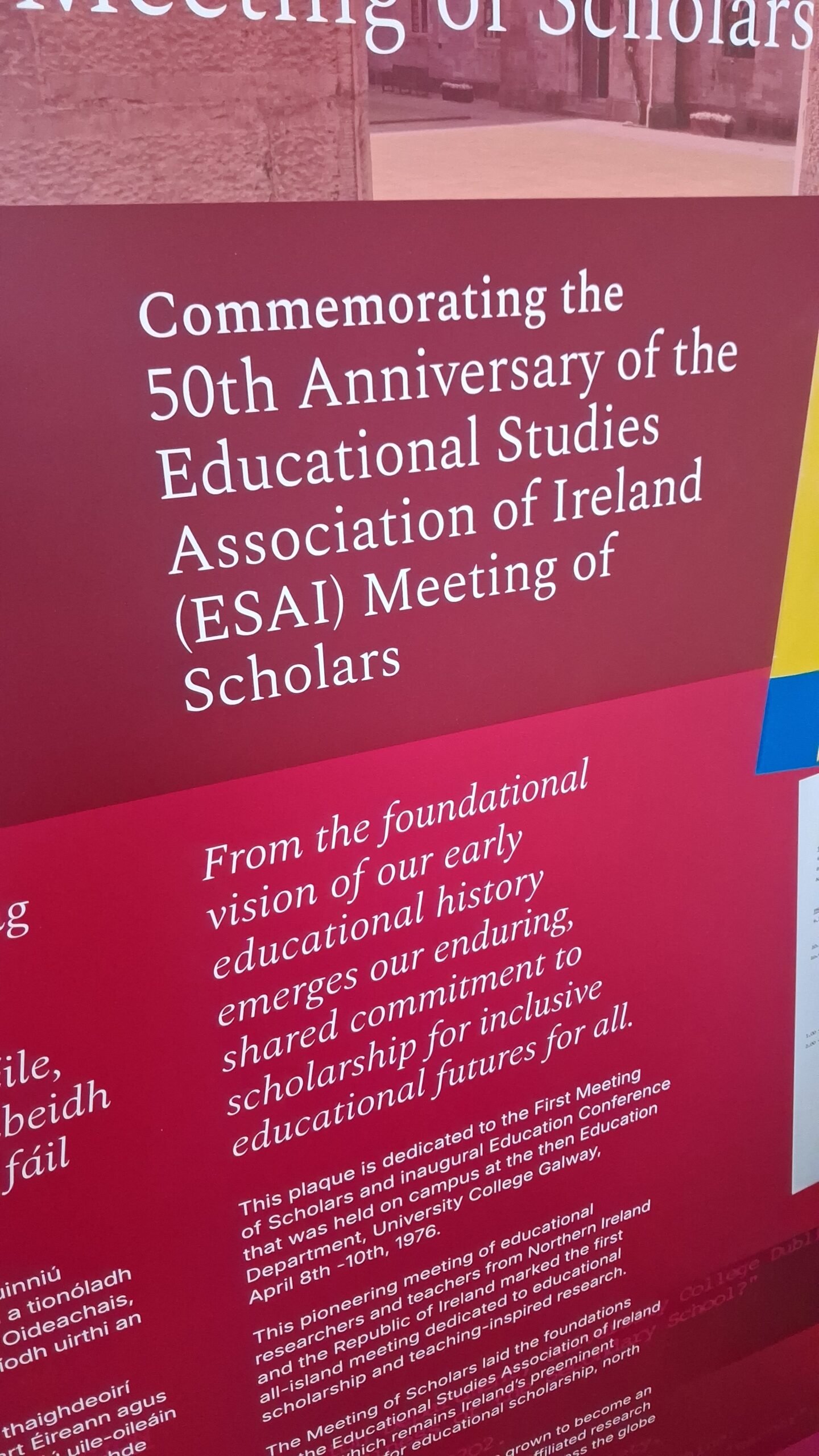
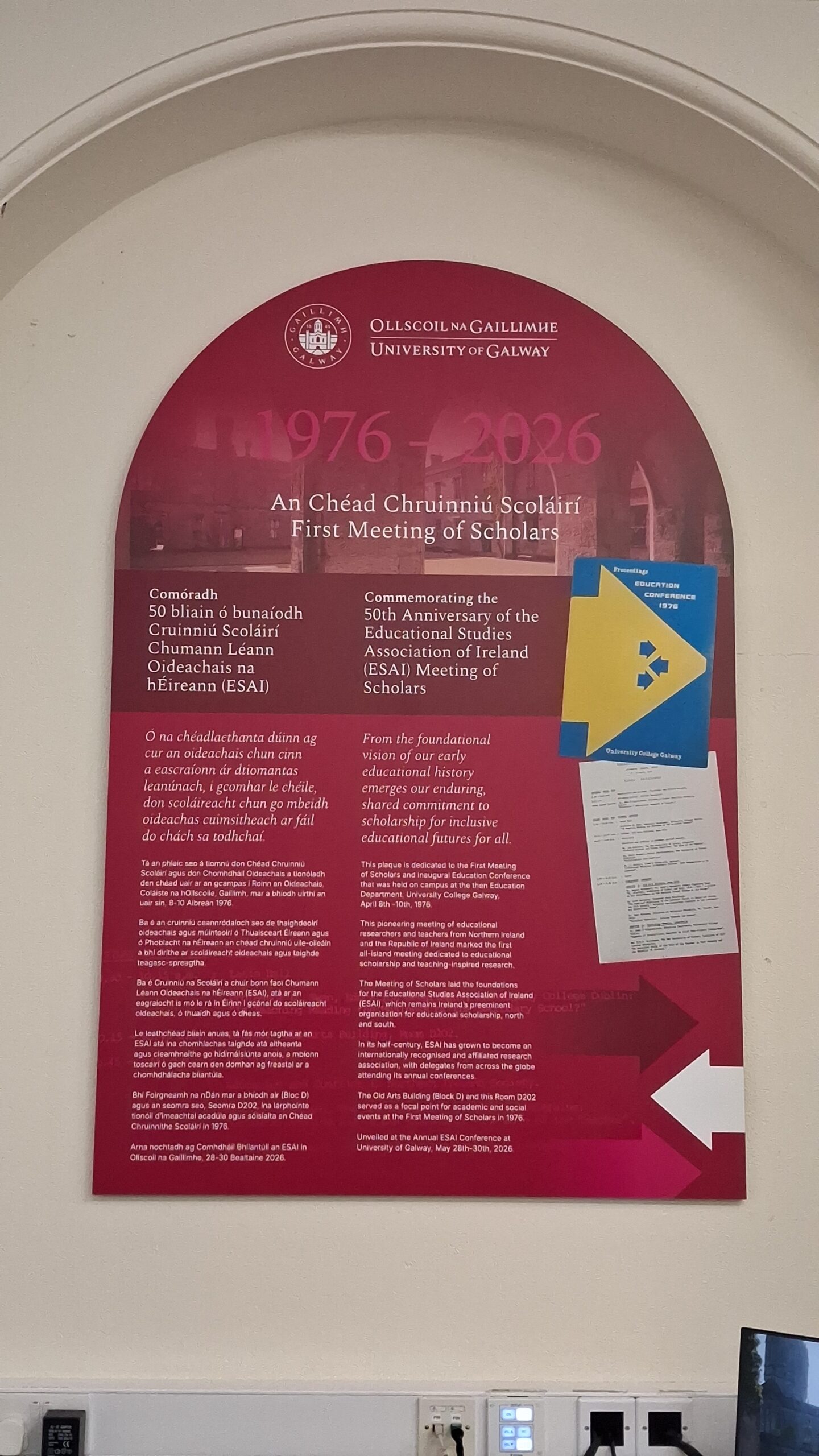
Commemorative events to celebrate ESAI’s foundations included the unveiling of a plaque in the University’s D Block (Old Arts Building), Room D202, a central campus location that served as a focal point for the first conference, and the launch of a 50th anniversary virtual special issue of the ESAI’s peer-reviewed international journal, Irish Educational Studies: “From foundations to frontiers: 50 years of educational research in Ireland”.
Reflecting on the history of the emergence and growth of educational research in Ireland is instructive for us today, as we live through complex times globally. These challenges were the principal focus of discussion at the World Education Research Association (WERA) expert panel in Los Angeles in April 2026, titled: Navigating Education Research Worldwide in a Time Dismissive of Evidence.
Ireland’s history during The Troubles was characterised by sectarian division and dismissiveness of the shared humanity of all communities. On the other hand, one sees how evidence – when it supports diversity and inclusion – can fundamentally change the world and create inclusive educational futures for all. Ireland in the 1950s and early 1960s was faced with a prevailing conservatism, including in terms of the outlook for education and educational access and provision. Professor Áine Hyland (2018), who was at the time an Executive Officer in the Department of Education, outlines the background with detail and concision:
“A Council of Education was set up by Minister Richard Mulcahy in 1950 and in November 1954, the council was asked to report on the curriculum of the secondary school. Its deliberations were long drawn out, and its Report on the Curriculum of the Secondary School was not completed until 1960 and was not published until 1962. It was a conservative report, and while it contained some interesting analyses of the secondary school curriculum of the time, it saw no need for any significant expansion of secondary schooling.”
It is a sobering reminder of how resistant systems can be to change, and of how much depends on those willing to challenge that resistance with evidence.
Fortunately for Ireland, as the country was changing, a number of Ministers for Education, the political leadership, and people, envisioned a different future. Crucially, it was evidence and research – in the form of the Investment in Education report of 1965 in particular – that presented “a devastating analysis of the Irish educational system”, making “a compelling case for radical reform”, as outlined by Hyland in her keynote address: 50 Years on: Reflecting on the legacy of free second level education at the 2018 ASTI Education Conference.
Consequently, on the 10th of September 1966, the Minister for Education, Donogh O’Malley – himself a UCG graduate – announced universal free second-level education for all children in Ireland. In his passionate and landmark speech on that auspicious Saturday, O’Malley described the lack of engagement in free second education as a “dark stain on the national conscience”.
The revolutionary scheme included free bus transport, to ensure those in remote and rural areas would not be disadvantaged. The initiative completely transformed Ireland, with broadcaster Joe Duffy calling free education a “miracle” (2017), and Professor Dermot Keogh noting: “free education was liberation for an entire generation of Irish schoolchildren and successive generations” (O’Mórdha, 2000). Its legacy continues to shape the country to this day, such that Ireland now has among the highest engagement in third-level education globally, as cited by the OECD in 2025.
ESAI, Pioneering the Future of Education
It is no coincidence that the 1976 meeting of ESAI happened within a decade of the introduction of free education. While we now face complex challenges in terms of potential dismissiveness of evidence, including educational scholarship, the time is ripe in Ireland for research to further grow and flourish. It is not possible within a brief summary such as this to outline all the impactful and innovative education research projects and initiatives currently being undertaken. Indeed, one only needs to peruse the programme for the 2026 ESAI conference at University of Galway to appreciate the breadth and impact of contemporary research, across all disciplines, and all ages and stages of education.
The diversity and plurality of methodologies employed in respective initiatives highlights how both qualitative and quantitative evidence, the so-called ‘big’ and ‘small’ data of educational research, are being heeded and utilised, to support educational inclusion. Today, the ESAI is an internationally affiliated research association, and its annual conferences attract delegates from around the globe. This year’s conference at University of Galway had over 400 delegates registered, from 18 countries. Furthermore, the association has its own international, peer-reviewed journal, Irish Educational Studies (Impact Factor: 1.2), published since 2005 by Routledge/Taylor & Francis.Although we live in turbulent times, organisations such as the ESAI, which support all scholars – from early career to emeritus – serve as essential, compelling fora for how evidence can be used to help us conceptualise and design inclusive educational futures for all.
Ireland now ranks among the highest in the world for participation in third-level education, as cited by the OECD in 2025, a remarkable achievement for a country that, just 60 years ago, saw little need to expand its secondary schools. Ireland was and is changing. That journey from conservatism to inclusion did not happen by accident. It happened because researchers, educators, and advocates insisted on the power of evidence-based research and education, precisely the work the ESAI has championed for 50 years. As the association looks to the next 50, that mission feels more urgent, and more necessary than ever, especially in the most challenging times, while we collaborate in peace, dialogue, and empathy; from Galway to the globe.


 Articles
 Podcasts
 Videos
 Publications
 Change Makers
 New Horizons
 In Focus
 Innovate Together
 Global Impact
 SDG Champion Edition
 Creative Galway
 Sustainability
 Equality
 Arts
Arts Business
 Law
Law Medicine
 MedTech
 Science
 Sport
Sport Sustainability
 Impact Toolkit & Case Studies
 Events