As Michael D. Higgins concludes his term as Uachtarán na hÉireann, the moment invites a warm and thoughtful look back at the extraordinary public life of one of University of Galway’s most distinguished alumni. Few are better placed to offer such reflection than Gearóid Ó Tuathaigh, Higgins’s lifelong friend and colleague, who provides a rare and personal glimpse into the man behind the office and the depth of his enduring connection to the University. Through public achievement and private loyalty, Higgins’s long association with University of Galway emerges as a defining thread in a remarkable life of service, intellect, and moral commitment.
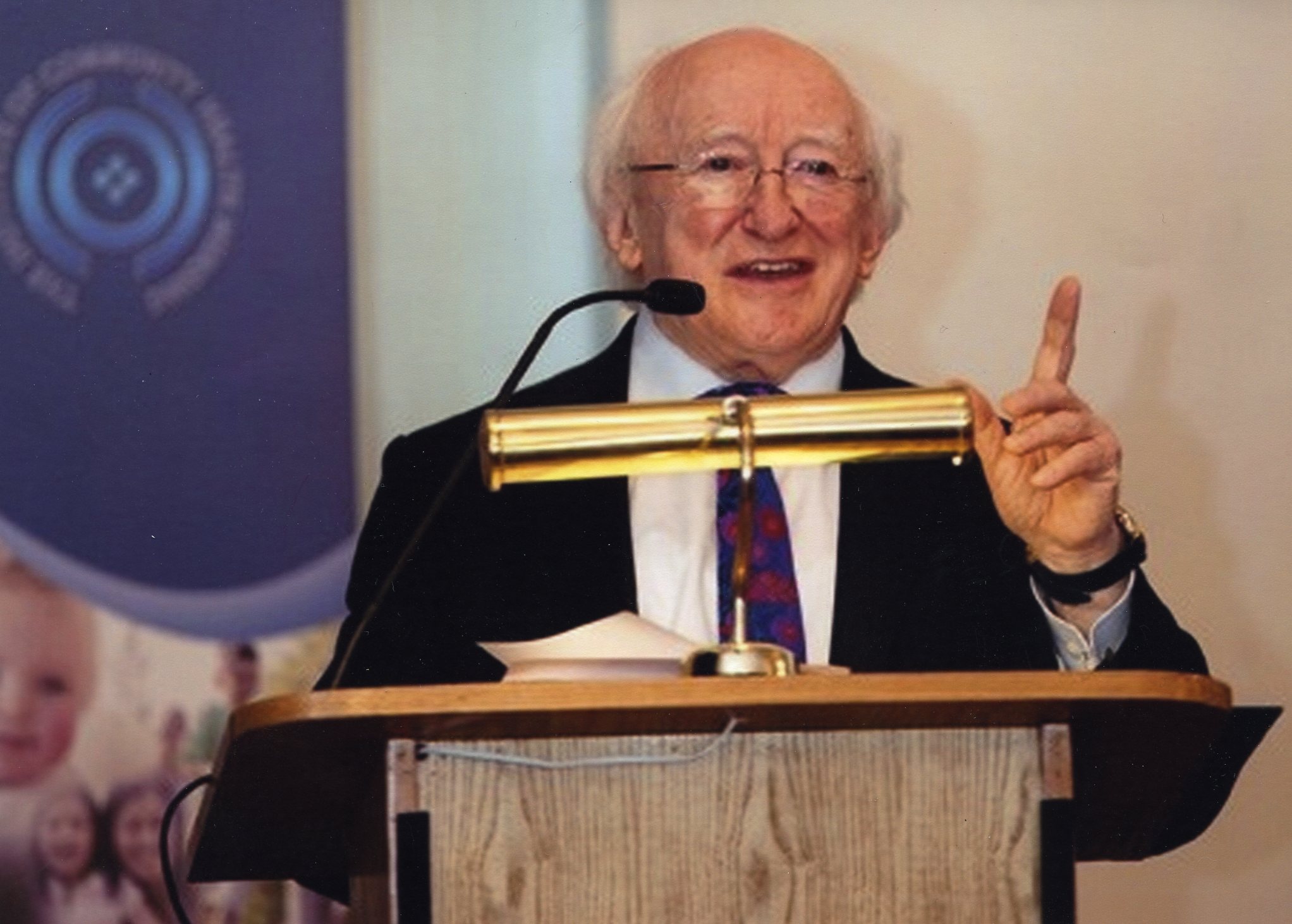
The completion of Michael D. Higgins’s term as Uachtarán na hÉireann offers an opportunity for a brief backward glance at select aspects of the extraordinary public life of one of our University’s most distinguished alumni, considered in the light of his long association with University of Galway.
The early life and family history of Michael D. – the profound effects of the revolutionary years and their aftermath on his family, and their enduring imprint on Michael D.’s own memory and on his understanding of struggle and sacrifice, of the brute facts of power, of life itself – will be familiar to many readers of Cois Coiribe. He has in the past spoken and written movingly and reflectively on the experiences of these years from childhood to early adulthood.
But it was here in Galway – in the ‘Aula’ of UCG, as it then was – on an autumn day in 1962 that Michael D. began his lifelong association with UCG, when he registered as a First Year student in Arts and in Commerce. Having already worked for a number of years in the city, he was a few years older than most First Years. I may note in passing that it was in the very early days after registration that I first met Michael D.: we found that we had mutual acquaintances and friends in an earlier generation and we recognised some common features of our cultural and social hinterland, and some shared interests. A friendship was forged early.
In considering the student days of those who later advanced to illustrious careers, there is a temptation to look for intimations of future directions and achievements. There is normally a need for caution in indulging this ‘backward glance’. In this particular instance, however, this is a temptation which need not be too strenuously resisted!
Michael D.’s impact as a student was immediate and powerful, notably in Debating. For students of the College in 1962, social life centred on campus activities to an extent scarcely imaginable today. In a compact campus, the ‘Lit and Deb’ (Literary and Debating Society) was the central forum, the Greek Hall in the Quad packed for its weekly debates. It was something of a bear-pit, in which the Auditor pleaded for good manners and speakers at the rostrum strove to master the boisterous crowd. Michael D. established such mastery from the earliest of his appearances. His assured declamatory style of advocacy and argument had an immediate impact. But there was more than passionate oratory in his armoury of persuasion. There was an agility of tone and temper when required: the sweeping hand gestures, the wry smile that regularly presaged the dispatch of a generous helping of irony in the direction of his adversary.
The performative talents were not confined to debating: he graced the boards in Dramsoc’s staging of Brecht’s The Good Person of Szechwan in the early 1960s.
Additionally, his early essays in writing – creative as well as critical – also date from his undergraduate years.
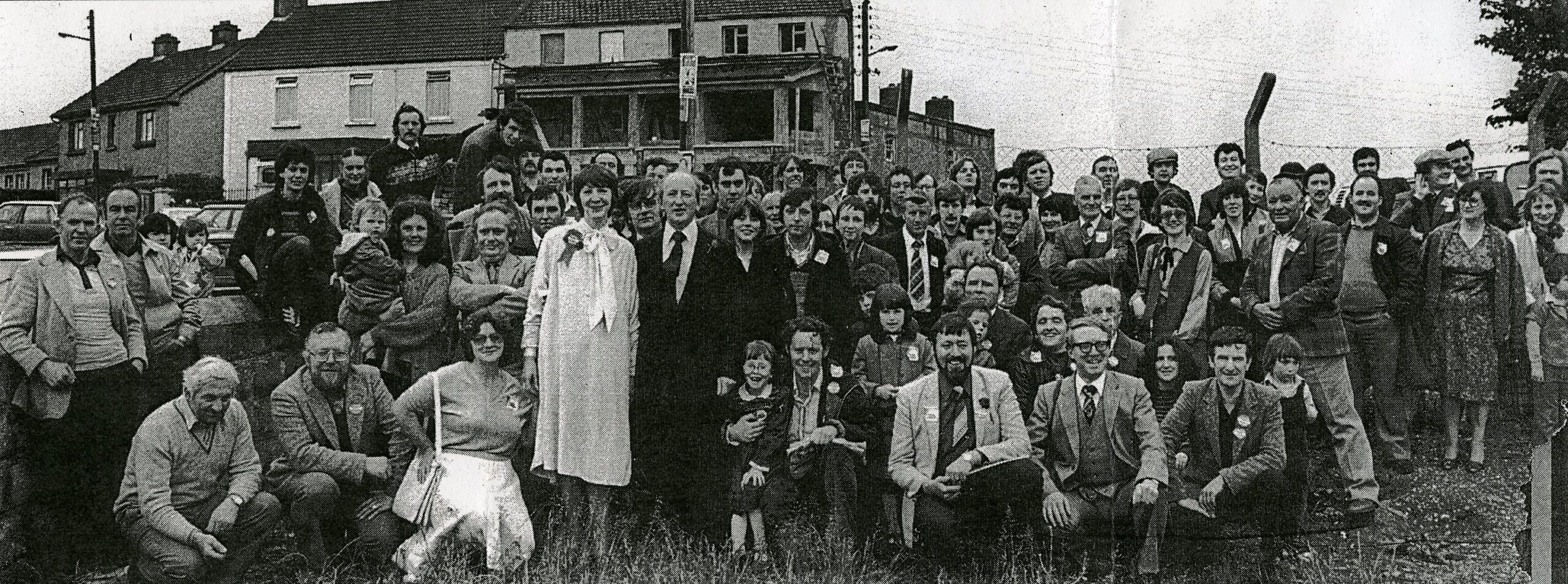
And, of course, the political instinct was also stirring, with Michael D.’s election as President of the Students Union in 1964/5. As President, he was assertive on behalf of students, in what was a solidly deferential culture of student politics in Galway at that time.
On the national stage in the Union of Students in Ireland (USI), it is fair to say that he was the trailblazer in forcing Galway to the centre of national debates and prominence within USI, on student welfare issues in Ireland and on certain international issues. As for later Galway student leaders – whether or not they went on to have careers in national politics, as some of them did – all were indebted to Michael D. for the path he had cleared.
May I also recall that, like many others, Michael D. worked the summers of his student years in England, earning the money to pay his way in College, and taking the opportunity for reading and writing poetry: then, as later, the quest was for bread and roses.
Postgraduate study in the University of Indiana and in Manchester was very important in Michael D.’s academic and intellectual development. Sociology was still a fledgling academic discipline in 1960s Ireland: strongly inflected with Catholic social thought in the NUI, as reflected in curricula and academic appointments. Indiana and Manchester exposed Michael D. to a wider span of ideas, concepts, and methodologies, generally fortifying his theoretical grounding. This would stand to him, in his later political, no less than in his academic, career.
On his return to Galway as a lecturer in Sociology in 1968, Michael D., not surprisingly, quickly acquired an enviable reputation as an inspiring lecturer. Again, in his research and publications, theoretical approaches were combined with engagement with concrete examples of contested social domains of power: teaching Durkheim did not exclude the study of working conditions and labour relations on Galway docks.
The academic years as lecturer coincided with his progressive engagement with political activism and electoral contests – and there were areas of overlap. He was among the founding cohort of the academic branch of the Workers’ Union of Ireland in UCG; at the time, many staff considered it unseemly for academics to be joining a trade union, not to mention a general workers union.
But the early stage of Michael D.’s entry into national politics was a turbulent time – the 1970s and 80s; locally there were the big beasts and formidable political machines of the two main parties to contend with. But he established his bridgehead, built his support base, and through his national profile in the Seanad and, ultimately, in the Dáil, by the later 1980s had a ‘secure’ (one never speaks in Ireland of a ‘safe’) Dáil seat in Galway.
In the context of his long university association, we may briefly draw attention to one particular aspect of Michael D.’s political career. The notion of ‘the intellectual in politics’ was (and perhaps still is) for some synonymous with ‘the impractical’, conjuring up a stereotype easily ridiculed, the absent-minded lodger in the mythical ivory tower.
Michael D. had to contend with this prejudice. But he did contend with it. As in his student days, he knew that passionate advocacy for rights, and justice and fairness, had to be seen to apply (and to have a demonstrable impact) in Shantalla or Seanaphéistín no less than in El Salvador.
And, when, in time, ministerial office came his way, those who felt that being at ease with theoretical issues or abstract ideas on ‘culture’ or ‘empowerment’ was incompatible with the practical (‘sleeves up’) application needed to ‘get things done’, were soon confounded by Michael D.’s record of ‘delivery’ when in office during 1993–97.
The post-ministerial years – the first decade or so of the early 21st century – were years in which, as President of the Labour Party and Labour Spokesman on Foreign Affairs – Michael D. enjoyed a certain ‘eminence’ : being by then a survivor of bruising battles, with a successful ministerial record, the gravitas of age and political seniority was beginning to return a dividend. But ‘eminence’ was not synonymous with a staid, quietist, or ‘über-circumspect’ disposition. On the contrary, the passion for championing ‘just causes’ (at home and globally) remained undiminished; evidenced by the forward positions taken by him on universal human rights and equality, and by his exertions in creating conditions for the nurturing and flowering of the creative instinct and capacity inherent in all people.
In seeking election to the Presidency in 2011, Michael D. promised that, if elected, his would be a ‘Presidency of ideas’. During the past 14 years he has been as good as his word. One might instance the continuing advocacy for human rights, the major Ethics Project, the ‘Machnamh 100’ programme, the flow of substantial publications, the inexhaustible championing of artists and creativity, and his insistence that ‘welfare’ is not only a material issue but a more ample set of requirements for humans striving to live in dignity. Reflections on the historic experience of Famine in Ireland have informed his challenging contributions to the global debate on food security, notably in Africa.
Agus, níl deireadh ráite ná déanta aige fós. Anois agus an saol ar a chomhairle fhéin aige arís, táim cinnte nach mbeidh sé díomhaoin. Beidh sé i mbun machnaimh agus pinn, agus cloisfear uaidh. I think we may be confident that the ferment of ideas and the passion for advocacy will continue in the post-Áras next stage of Michael D.’s remarkable personal camino of public service.
Gearóid Ó Tuathaigh
—
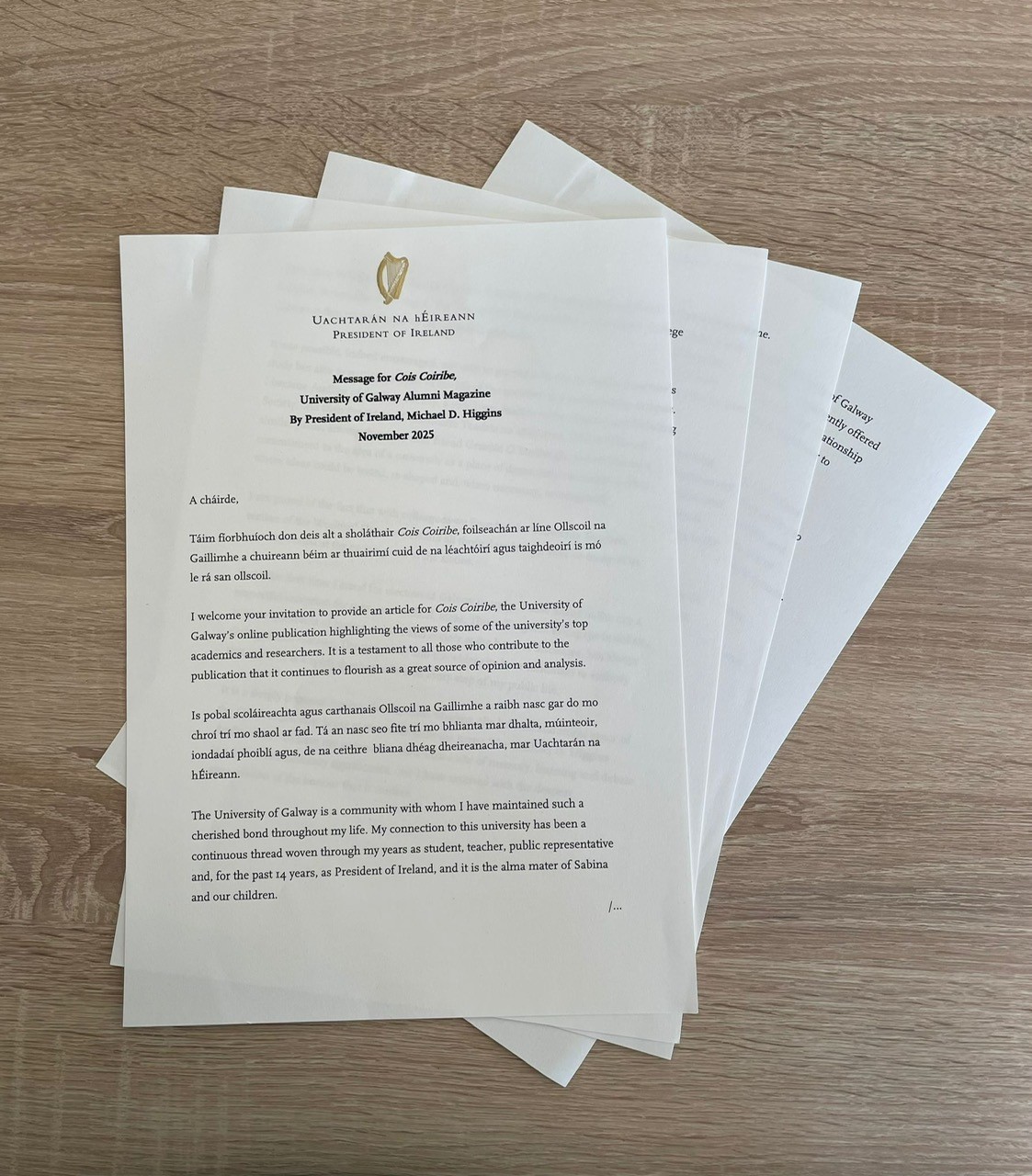
To read Michael D. Higgins’s letter to Cois Coiribe, head over to our University’s winter 2025 alumni magazine edition, New Horizons!
A cháirde,
Táim fíorbhuíoch as an deis a fháil alt a sholáthair Cois Coiribe, foilseachán Ollscoil na Gaillimhe na chuireann béim ar thuairimí cuid de na léachtóirí agus taighdeoirí is mó le rá san ollscoil.
I welcome your invitation to provide an article for Cois Coiribe, University of Galway’s publication highlighting the views of some of the University’s top academics and researchers. It is a testament to all those who contribute to the publication that it continues to flourish as a great source of opinion and analysis. [KEEP READING…]
Profiles

Prof Gearóid Ó Tuathaigh is Professor Emeritus in History and former Dean of Arts and Vice-President of University of Galway. He was appointed to the Council of State by the President of Ireland, Michael D. Higgins in 2012. Prof Ó Tuathaigh graduated with a BA from the University followed by an MA. He completed his postgraduate studies at Peterhouse College, Cambridge, and he received an Honorary Doctorate from NUI Galway in 2017.


 Articles
 Podcasts
 Videos
 Publications
 New Horizons
 In Focus
 Innovate Together
 Global Impact
 SDG Champion Edition
 Creative Galway
 AI & Human Creativity
 Sustainability
 Equality
 Arts
Arts Business
 Law
Law Medicine
 MedTech
 Science
 Sport
Sport Sustainability
 Impact Toolkit & Case Studies
 Events